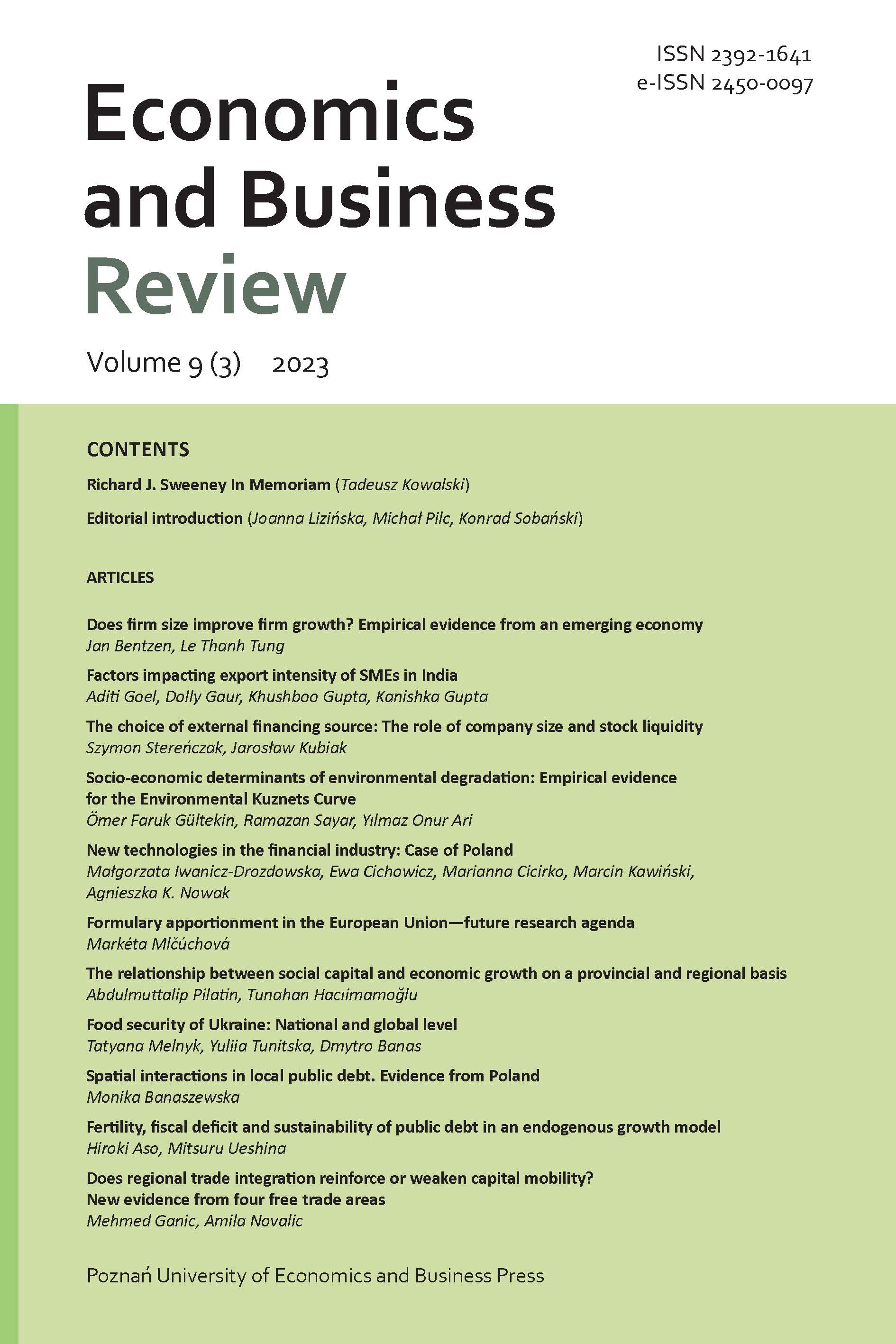
New technologies in the financial industry: case of Poland
DOI:
https://doi.org/10.18559/ebr.2023.3.926Keywords:
cloud computing, artificial intelligence, new technologies, innovationAbstract
This study evaluates the scope and consequences of the application of new technologies (NTs) within the Polish banking and insurance sectors and thus contributes to the knowledge of CEE financial market development. The goal is to understand the implementation of particular NTs in two different sectors and identify the motivations, strategies, phases of realisation and cost efficiency depending on the institution’s size. The detail of the study requires the use of qualitative research methods. In-depth interviews are employed to figure out the criteria based on which decisions to implement NTs are made. The findings indicate that the primary objective of NT implementation is to respond to customers’ needs, followed by cost-cutting and achieving more efficient internal processes. The application of artificial intelligence (AI) and machine learning (ML) in risk management areas is still a work in progress. In the next five years cloud computing is expected to become the most important NT and thus will have to meet numerous regulatory requirements.
Downloads
References
Aashima, & Mohanty, B. (2022). How blockchain can transform the financial services ındustry. In K. Sood, R. K. Dhanaraj, B. Balusamy & S. Kadry (Eds.), Blockchain technology in corporate governance (pp. 253–281). https://doi.org/10.1002/9781119865247.ch12
View in Google Scholar
DOI: https://doi.org/10.1002/9781119865247.ch12
Altman, E., Iwanicz-Drozdowska, M., Laitinen, E., & Suvas, A. (2020). A race for long horizon bankruptcy prediction. Applied Economics, 52(37), 4092–4111. https://doi.org/10.1080/00036846.2020.1730762
View in Google Scholar
DOI: https://doi.org/10.1080/00036846.2020.1730762
Barboza, F., Kimura, H., & Altman, E. (2017). Machine learning models and bankruptcy prediction. Expert Systems with Applications, 83, 405-417. https://doi.org/10.1016/j.eswa.2017.04.006
View in Google Scholar
DOI: https://doi.org/10.1016/j.eswa.2017.04.006
Boot, A., Hoffmann, P., Laeven, L., & Ratnovski, L. (2021). FinTech: What’s old, what’s new? Journal of Financial Stability, 53, 100836. https://doi.org/10.1016/jjfs.2020.100836
View in Google Scholar
DOI: https://doi.org/10.1016/j.jfs.2020.100836
Cata, T., & Lee, S. M. (2006). Adoption of web-based applications in the financial sector: The case of online insurance. Journal of Internet Commerce, 5(2), 41–61. https://doi.org/10.1300/J179v05n02_03
View in Google Scholar
DOI: https://doi.org/10.1300/J179v05n02_03
Cashless. (2021). The map of Polish Fintech. https://www.cashless.pl/report/mapa-polskiego-fintechu-2021-ang.pdf
View in Google Scholar
Durkin, M., Jennings, D., Mulholland, G., & Worthington, S. (2008). Key influencers and inhibitors on adoption of the Internet for banking. Journal of Retailing and Consumer Services, 15(5), 348–357. https://doi.org/10.1016/j.jretconser.2007.08.002
View in Google Scholar
DOI: https://doi.org/10.1016/j.jretconser.2007.08.002
Eling, M., Nuessle, D., & Staubli, J. (2022). The impact of artificial intelligence along the insurance value chain and on the insurability of risks. The Geneva Papers on Risk and Insurance – Issues and Practice, 47, 205–241. https://doi.org/10.1057/s41288-020-00201-7
View in Google Scholar
DOI: https://doi.org/10.1057/s41288-020-00201-7
Faridpour, M., & Moradi, A. (2020). A novel method for detection of fraudulent bank transactions using multi-layer neural networks with adaptive learning rate. International Journal of Nonlinear Analysis and Applications, 11(2), 437–445. https://doi.org/10.22075/ijnaa.2020.4576
View in Google Scholar
Harasim, J. (2021). FinTechs, BigTechs and banks—when cooperation and when competition? Journal of Risk and Financial Management, 14(12), 614. https://doi.org/10.3390/jrfm14120614
View in Google Scholar
DOI: https://doi.org/10.3390/jrfm14120614
Hu, X. (2005). A data mining approach for retailing bank customer attrition analysis. Applied Intelligence, 22(1), 47–60. https://doi.org/10.1023/B:APIN.0000047383.53680.b6
View in Google Scholar
DOI: https://doi.org/10.1023/B:APIN.0000047383.53680.b6
Jünger, M., & Mietzner, M. (2020). Banking goes digital: The adoption of FinTech services by German households. Finance Research Letters, 34, 101260. https://doi.org/10.1016/j.frl.2019.08.008
View in Google Scholar
DOI: https://doi.org/10.1016/j.frl.2019.08.008
Kitsios, F., Giatsidis, I., & Kamariotou, M. (2021). Digital transformation and strategy in the banking sector: Evaluating the acceptance rate of e-services. Journal of Open Innovation: Technology, Market, and Complexity, 7(3), 204. https://doi.org/10.3390/joitmc7030204
View in Google Scholar
DOI: https://doi.org/10.3390/joitmc7030204
Kliber, A., Będowska-Sójka, B., Rutkowska, A., & Świerczyńska, K. (2021). Triggers and obstacles to the development of the FinTech sector in Poland. Risks, 9(2), 30. https://doi.org/10.3390/risks9020030
View in Google Scholar
DOI: https://doi.org/10.3390/risks9020030
Lee-Ying, T., Hen-Toong, T., & Gek-Siang, T. (2022). Digital financial inclusion: A gateway to sustainable development, Heliyon, 8(6). https://doi.org/10.1016/j.heliyon.2022.e09766
View in Google Scholar
DOI: https://doi.org/10.1016/j.heliyon.2022.e09766
Marano, P., & Li, S. (2023) Regulating robo-advisors in ınsurance distribution: Lessons from the Insurance Distribution Directive and the AI Act. Risks, 11(1), 12. https://doi.org/10.3390/risks11010012
View in Google Scholar
DOI: https://doi.org/10.3390/risks11010012
Menendez, S., & Hassani, B.(2021). Expected shortfall reliability—added value of traditional statistics and advanced artificial ıntelligence for market risk measurement purposes. Mathematics, 9(17), 2142. https://doi.org/10.3390/math9172142
View in Google Scholar
DOI: https://doi.org/10.3390/math9172142
Metawa, N., Hassan, M. K., & Metawa, S. (2023). Artificial ıntelligence and big data for financial risk management. Intelligent applications. Routledge.
View in Google Scholar
DOI: https://doi.org/10.4324/9781003144410
Miguel-Dávila, J. Á., Cabeza-García, L., Valdunciel, L., & Flórez, M. (2010). Operations in banking: The service quality and effects on satisfaction and loyalty. Service Industries Journal, 30(13), 2163–2182. https://doi.org/10.1080/02642060903289936
View in Google Scholar
DOI: https://doi.org/10.1080/02642060903289936
Muganyi, T., Yan, L., Yin, Y., Sun, H., Gong, X., & Taghizadeh-Hesary F. (2022). FinTech, RegTech, and financial development: Evidence from China. Financial Innovation, 8(29) https://doi.org/10.1186/s40854-021-00313-6
View in Google Scholar
DOI: https://doi.org/10.1186/s40854-021-00313-6
Piotrowski, D. (2023). Privacy frontiers in customers’ relations with banks. Economics and Business Review, 9(1), 119–141. https://doi.org/10.18559/ebr.2023.1.5
View in Google Scholar
DOI: https://doi.org/10.18559/ebr.2023.1.5
Prisznyák, A. (2022). Bankrobotics: Artificial ıntelligence and machine learning powered banking risk management prevention of money laundering and terrorist financing. Public Finance Quarterly, 67(2), 288–303. https://journals.lib.uni-corvinus.hu/index.php/penzugyiszemle/article/view/1194/629
View in Google Scholar
DOI: https://doi.org/10.35551/PFQ_2022_2_8
PwC. (2022). Uncovering the ground truth: AI in Indian financial services. PricewaterhouseCoopers Private Limited.
View in Google Scholar
Selimović, J., Pilav-Velić, A., & Krndžija, L. (2021). Digital workplace transformation in the financial service sector: Investigating the relationship between employees’ expectations and intentions, Technology in Society, 66, 101640. https://doi.org/10.1016/j.techsoc.2021.101640
View in Google Scholar
DOI: https://doi.org/10.1016/j.techsoc.2021.101640
Shala, A., & Perri, R. (2022). Regulatory barriers for fintech companies in Central and Eastern Europe. Eastern Journal of European Studies, 13(2), 292–316. https://doi.org/10.47743/ejes-2022-0214
View in Google Scholar
DOI: https://doi.org/10.47743/ejes-2022-0214
Siddik, M. N. A., & Kabiraj, S. (2020). Digital finance for financial inclusion and inclusive growth. In B. George & J. Paul (Eds.), Digital transformation in business and society (pp. 155–168). Palgrave Macmillan. https://doi.org/10.1007/978-3-030-08277-2_10
View in Google Scholar
DOI: https://doi.org/10.1007/978-3-030-08277-2_10
Solarz, M., & Adamek, J. (2022). Determinants of digital financial exclusion as a barrier to the adoption of mobile banking services in Poland. Ekonomia i Prawo, 21(2), 503–525. https://doi.org/10.12775/eip.2022.028
View in Google Scholar
DOI: https://doi.org/10.12775/EiP.2022.028
Steiner, P. H., & Maas, P. (2018). When customers are willing to disclose information in the insurance industry: A multi-group analysis comparing ten countries. International Journal of Bank Marketing, 36(6), 1015–1033. https://doi. org/10.1108/IJBM-12-2016-0183
View in Google Scholar
DOI: https://doi.org/10.1108/IJBM-12-2016-0183
Trivedi, S. K. (2020). A study on credit scoring modeling with different feature selection and machine learning approaches. Technology in Society, 63, 101413. https:// doi.org/10.1016/j.techsoc.2020.101413
View in Google Scholar
DOI: https://doi.org/10.1016/j.techsoc.2020.101413
Wang, C., Qiao, C., Ahmed, R. I., & Kirikkaleli, D. (2021). Institutional quality, bank finance and technological ınnovation: A way forward for Fourth Industrial Revolution in BRICS Economies. Technological Forecasting and Social Change, 163, 120427. https://doi.org/10.1016/j.techfore.2020.120427
View in Google Scholar
DOI: https://doi.org/10.1016/j.techfore.2020.120427
Wang, M., Cho, S., & Denton, T. (2017). The impact of personalisation and compatibility with past experience on e-banking usage. International Journal of Bank Marketing, 35(1), 45–55. https://doi.org/10.1108/IJBM-04-2015-0046
View in Google Scholar
DOI: https://doi.org/10.1108/IJBM-04-2015-0046
Downloads
Published
Versions
- 2023-10-12 (2)
- 2023-09-20 (1)
Issue
Section
License
Copyright (c) 2023 Małgorzata Iwanicz-Drozdowska , Ewa Cichowicz, Marianna Cicirko, Marcin Kawiński , Agnieszka K. Nowak

This work is licensed under a Creative Commons Attribution 4.0 International License.