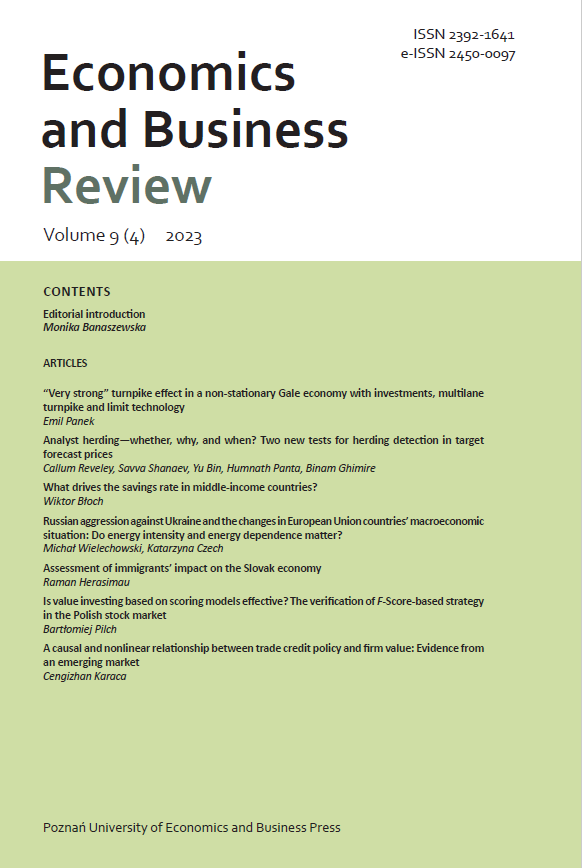
Analyst herding – whether, why, and when? Two new tests for herding detection in target forecast prices
DOI:
https://doi.org/10.18559/ebr.2023.4.892Keywords:
behavioural finance, herding, econometric modelsAbstract
This study proposes two novel tests for security analyst herding based on binomial correlation and forecast error volatility scaling and applies it to investigate herding patterns in analyst target prices in 2008-2020 in the UK. Analysts robustly herd in their valuations, with results consistent across years, sectors, in panel fixed effect, quantile, instrumental variable regressions, and when controlled for optimism and conservatism. Herding becomes prominent for stocks followed by at least five analysts and towards the long sides of Fama-French sorts, reinforcing its non-spurious and behavioral nature. Analyst herd more strongly subject to low volatility and uncertainty.
Downloads
References
Abarbanell, J., & Lehavy, R. (2003). Biased forecasts or biased earnings? The role of reported earnings in explaining apparent bias and over/underreaction in analysts’ earnings forecasts. Journal of Accounting and Economics, 36(1-3), 105-146.
View in Google Scholar
DOI: https://doi.org/10.1016/j.jacceco.2003.11.001
Aharon, D. Y. (2021). Uncertainty, fear and herding behavior: Evidence from size-ranked portfolios. Journal of Behavioral Finance, 22(3), 320-337.
View in Google Scholar
DOI: https://doi.org/10.1080/15427560.2020.1774887
Anderson, T., & Rubin, H. (1949). Estimation of the parameters of a single equation in a complete system of stochastic equations. Annals of Mathematical Statistics, 20(1), 46-63.
View in Google Scholar
DOI: https://doi.org/10.1214/aoms/1177730090
Argenti, P. (2020). Communicating through the coronavirus crisis. Harvard Business Review.
View in Google Scholar
Bernhardt, D., Campello, M., & Kutsoati, E. (2006). Who herds? Journal of Financial Economics, 80(3), 657-675.
View in Google Scholar
DOI: https://doi.org/10.1016/j.jfineco.2005.07.006
Blake, D., Sarno, L., & Zinna, G. (2017). The market for lemmings: The herding behavior of pension funds. Journal of Financial Markets, 36(1), 17-39.
View in Google Scholar
DOI: https://doi.org/10.1016/j.finmar.2017.03.001
Blasco, N., Corredor, P., & Ferrer, E. (2018). Analysts herding: When does sentiment matter? Applied Economics, 50(51), 5495-5509.
View in Google Scholar
DOI: https://doi.org/10.1080/00036846.2018.1486999
Bradshaw, M., Brown, L., & Huang, K. (2013). Do sell-side analysts exhibit differential target price forecasting ability? Review of Accounting Studies, 18(4), 930-955.
View in Google Scholar
DOI: https://doi.org/10.1007/s11142-012-9216-5
Bradshaw, M., Huang, A., & Tan, H. (2014). Analyst target price optimism around the world. Working paper, Boston College.
View in Google Scholar
Brav, A., & Lehavy, R. (2003). An empirical analysis of analysts' target prices: Short‐term informativeness and long‐term dynamics. Journal of Finance, 58(5), 1933-1967.
View in Google Scholar
DOI: https://doi.org/10.1111/1540-6261.00593
Caparrelli, F., D'Arcangelis, A., & Cassuto, A. (2004). Herding in the Italian stock market: a case of behavioral finance. Journal of Behavioral Finance, 5(4), 222-230.
View in Google Scholar
DOI: https://doi.org/10.1207/s15427579jpfm0504_5
Chang, E., Cheng, J., & Khorana, A. (2000). An examination of herd behavior in equity markets: An international perspective. Journal of Banking & Finance, 24(10), 1651-1679.
View in Google Scholar
DOI: https://doi.org/10.1016/S0378-4266(99)00096-5
Chen, Q., & Jiang, W. (2006). Analysts’ weighting of private and public information. Review of Financial Studies, 19(1), 319-355.
View in Google Scholar
DOI: https://doi.org/10.1093/rfs/hhj007
Cheng, L., Su, Y., Yan, Z., & Zhao, Y. (2019). Corporate governance and target price accuracy. International Review of Financial Analysis, 64(1), 93-101.
View in Google Scholar
DOI: https://doi.org/10.1016/j.irfa.2019.05.005
Choi, N., & Sias, R. (2009). Institutional industry herding. Journal of Financial Economics, 94(3), 469-491.
View in Google Scholar
DOI: https://doi.org/10.1016/j.jfineco.2008.12.009
Choi, N., & Skiba, H. (2015). Institutional herding in international markets. Journal of Banking & Finance, 55(1), 246-259.
View in Google Scholar
DOI: https://doi.org/10.1016/j.jbankfin.2015.02.002
Chow, G. (1960). Tests of equality between sets of coefficients in two linear regressions. Econometrica: Journal of the Econometric Society, 28(3), 591-605.
View in Google Scholar
DOI: https://doi.org/10.2307/1910133
Christie, W., & Huang, R. (1995). Following the pied piper: Do individual returns herd around the market? Financial Analysts Journal, 51(4), 31-37.
View in Google Scholar
DOI: https://doi.org/10.2469/faj.v51.n4.1918
Clement, M., & Tse, S. (2005). Financial analyst characteristics and herding behavior in forecasting. Journal of Finance, 60(1), 307-341.
View in Google Scholar
DOI: https://doi.org/10.1111/j.1540-6261.2005.00731.x
Collins, J. & Porras, J. (1996). Building your company's vision. Harvard Business Review, 74(5), 65-77.
View in Google Scholar
Cote, J., & Goodstein, J. (1999). A breed apart? Security analysts and herding behavior. Journal of Business Ethics, 18(3), 305-314.
View in Google Scholar
DOI: https://doi.org/10.1023/A:1005889208165
Da, Z., & Schaumburg, E. (2011). Relative valuation and analyst target price forecasts. Journal of Financial Markets, 14(1), 161-192.
View in Google Scholar
DOI: https://doi.org/10.1016/j.finmar.2010.09.001
De Bondt, W., & Forbes, W. (1999). Herding in analyst earnings forecasts: evidence from the United Kingdom. European Financial Management, 5(2), 143-163.
View in Google Scholar
DOI: https://doi.org/10.1111/1468-036X.00087
Doukas, J., Kim, C., & Pantzalis, C. (2005). The two faces of analyst coverage. Financial Management, 34(2), 99-125.
View in Google Scholar
DOI: https://doi.org/10.1111/j.1755-053X.2005.tb00101.x
Drehmann, M., Oechssler, J., & Roider, A. (2005). Herding and contrarian behavior in financial markets: An internet experiment. American Economic Review, 95(5), 1403-1426.
View in Google Scholar
DOI: https://doi.org/10.1257/000282805775014317
Fama, E., & French, K. (2015). A five-factor asset pricing model. Journal of Financial Economics, 116(1), 1-22.
View in Google Scholar
DOI: https://doi.org/10.1016/j.jfineco.2014.10.010
Fama, E., & French, K. (2018). Choosing factors. Journal of Financial Economics, 128(2), 234-252.
View in Google Scholar
DOI: https://doi.org/10.1016/j.jfineco.2018.02.012
Feldman, R., Livnat, J., & Zhang, Y. (2012). Analysts’ earnings forecast, recommendation, and target price revisions. Journal of Portfolio Management, 38(3), 120-132.
View in Google Scholar
DOI: https://doi.org/10.3905/jpm.2012.38.3.120
Frazzini, A., & Pedersen, L. (2014). Betting against beta. Journal of Financial Economics, 111(1), 1-25.
View in Google Scholar
DOI: https://doi.org/10.1016/j.jfineco.2013.10.005
Frijns, B., & Huynh, T. (2018). Herding in analysts’ recommendations: The role of media. Journal of Banking & Finance, 91(1), 1-18.
View in Google Scholar
DOI: https://doi.org/10.1016/j.jbankfin.2018.03.010
Galariotis, E., Rong, W., & Spyrou, S. (2015). Herding on fundamental information: A comparative study. Journal of Banking & Finance, 50(1), 589-598.
View in Google Scholar
DOI: https://doi.org/10.1016/j.jbankfin.2014.03.014
Graham, J. (1999). Herding among investment newsletters: Theory and evidence. Journal of Finance, 54(1), 237-268.
View in Google Scholar
DOI: https://doi.org/10.1111/0022-1082.00103
Guo, J., Holmes, P., & Altanlar, A. (2020). Is herding spurious or intentional? Evidence from analyst recommendation revisions and sentiment. International Review of Financial Analysis, 71(1), 101539.
View in Google Scholar
DOI: https://doi.org/10.1016/j.irfa.2020.101539
Han, C., Kang, J., & Kim, S. (2021). Betting against analyst target price. Journal of Financial Markets.
View in Google Scholar
DOI: https://doi.org/10.1016/j.finmar.2021.100677
Hong, H., & Kacperczyk, M. (2010). Competition and bias. The Quarterly Journal of Economics, 125(4), 1683-1725.
View in Google Scholar
DOI: https://doi.org/10.1162/qjec.2010.125.4.1683
Huang, J., Mian, G., & Sankaraguruswamy, S. (2009). The value of combining the information content of analyst recommendations and target prices. Journal of Financial Markets, 12(4), 754-777.
View in Google Scholar
DOI: https://doi.org/10.1016/j.finmar.2009.07.002
Hwang, S., & Salmon, M. (2004). Market stress and herding. Journal of Empirical Finance, 11(4), 585-616.
View in Google Scholar
DOI: https://doi.org/10.1016/j.jempfin.2004.04.003
Imam, S., Chan, J., & Shah, S. (2013). Equity valuation models and target price accuracy in Europe: Evidence from equity reports. International Review of Financial Analysis, 28(1), 9-19.
View in Google Scholar
DOI: https://doi.org/10.1016/j.irfa.2013.02.008
Ishigami, S., & Takeda, F. (2018). Market reactions to stock rating and target price changes in analyst reports: Evidence from Japan. Journal of International Financial Markets, Institutions and Money, 52(1), 134-151.
View in Google Scholar
DOI: https://doi.org/10.1016/j.intfin.2017.09.014
James, C., & Karceski, J. (2006). Strength of analyst coverage following IPOs. Journal of Financial Economics, 82(1), 1-34.
View in Google Scholar
DOI: https://doi.org/10.1016/j.jfineco.2005.09.003
JPMorgan (1997). CreditMetrics – technical document. JPMorgan, New York.
View in Google Scholar
Kim, C., & Pantzalis, C. (2003). Global/industrial diversification and analyst herding. Financial Analysts Journal, 59(2), 69-79.
View in Google Scholar
DOI: https://doi.org/10.2469/faj.v59.n2.2515
Koenker, R., & Bassett, G. (1978). Regression quantiles. Econometrica: Journal of the Econometric Society, 46(1), 33-50.
View in Google Scholar
DOI: https://doi.org/10.2307/1913643
Kremer, S., & Nautz, D. (2013). Causes and consequences of short-term institutional herding. Journal of Banking & Finance, 37(5), 1676-1686.
View in Google Scholar
DOI: https://doi.org/10.1016/j.jbankfin.2012.12.006
Lee, J., & Lee, J. (2015). Analyst herding behavior and analyst affiliation: Evidence from business groups. Journal of Behavioral Finance, 16(4), 373-386.
View in Google Scholar
DOI: https://doi.org/10.1080/15427560.2015.1098640
Lin, M. (2018). The impact of aggregate uncertainty on herding in analysts' stock recommendations. International Review of Financial Analysis, 57(1), 90-105.
View in Google Scholar
DOI: https://doi.org/10.1016/j.irfa.2018.02.006
Lin, S., Tan, H., & Zhang, Z. (2016). When analysts talk, do institutional investors listen? Evidence from target price changes. Financial Review, 51(2), 191-223.
View in Google Scholar
DOI: https://doi.org/10.1111/fire.12102
Nakamura, A., & Nakamura, M. (1981). On the relationships among several specification error tests presented by Durbin, Wu, and Hausman. Econometrica, 49(6), 1583-1588.
View in Google Scholar
DOI: https://doi.org/10.2307/1911420
Nofsinger, J., & Sias, R. (1999). Herding and feedback trading by institutional and individual investors. Journal of Finance, 54(6), 2263-2295.
View in Google Scholar
DOI: https://doi.org/10.1111/0022-1082.00188
O'Brien, P. (1988). Analysts' forecasts as earnings expectations. Journal of Accounting and Economics, 10(1), 53-83.
View in Google Scholar
DOI: https://doi.org/10.1016/0165-4101(88)90023-7
O'Brien, P., & Bhushan, R. (1990). Analyst following and institutional ownership. Journal of Accounting Research, 28(1), 55-76.
View in Google Scholar
DOI: https://doi.org/10.2307/2491247
Olsen, R. (1996). Implications of herding behavior for earnings estimation, risk assessment, and stock returns. Financial Analysts Journal, 52(4), 37-41.
View in Google Scholar
DOI: https://doi.org/10.2469/faj.v52.n4.2009
Roider, A., & Voskort, A. (2016). Reputational herding in financial markets: A laboratory experiment. Journal of Behavioral Finance, 17(3), 244-266.
View in Google Scholar
DOI: https://doi.org/10.1080/15427560.2016.1203322
Roger, T., Roger, P., & Schatt, A. (2018). Behavioral bias in number processing: Evidence from analysts’ expectations. Journal of Economic Behavior & Organization, 149(1), 315-331.
View in Google Scholar
DOI: https://doi.org/10.1016/j.jebo.2018.02.026
Scharfstein, D., & Stein, J. (1990). Herd behavior and investment. American Economic Review, 80(3), 465-479.
View in Google Scholar
Shanaev, S., & Ghimire, B. (2021). Efficient scholars: academic attention and the disappearance of anomalies. The European Journal of Finance, 27(3), 278-304.
View in Google Scholar
DOI: https://doi.org/10.1080/1351847X.2020.1812684
Sias, R. (2004). Institutional herding. Review of Financial Studies, 17(1), 165-206.
View in Google Scholar
DOI: https://doi.org/10.1093/rfs/hhg035
Trueman, B. (1994). Analyst forecasts and herding behavior. Review of Financial Studies, 7(1), 97-124.
View in Google Scholar
DOI: https://doi.org/10.1093/rfs/7.1.97
Vidal-Tomas, D., Ibanez, A., & Farinos, J. (2019). Herding in the cryptocurrency market: CSSD and CSAD approaches. Finance Research Letters, 30(1), 181-186.
View in Google Scholar
DOI: https://doi.org/10.1016/j.frl.2018.09.008
Wang, Z., Sun, L., & Wei, K. (2020). Does competition induce analyst effort? Evidence from a natural experiment of broker mergers. Journal of Banking & Finance, 119(1), 105914.
View in Google Scholar
DOI: https://doi.org/10.1016/j.jbankfin.2020.105914
Welch, I. (2000). Herding among security analysts. Journal of Financial Economics, 58(3), 369-396.
View in Google Scholar
DOI: https://doi.org/10.1016/S0304-405X(00)00076-3
Young, A. (2019). Consistency without inference: Instrumental variables in practical application. London School of Economics.
View in Google Scholar
Downloads
Published
Issue
Section
License
Copyright (c) 2023 Binam Ghimire, Callum Reveley, Savva Shanaev, Humnath Panta, Yu Bin

This work is licensed under a Creative Commons Attribution 4.0 International License.