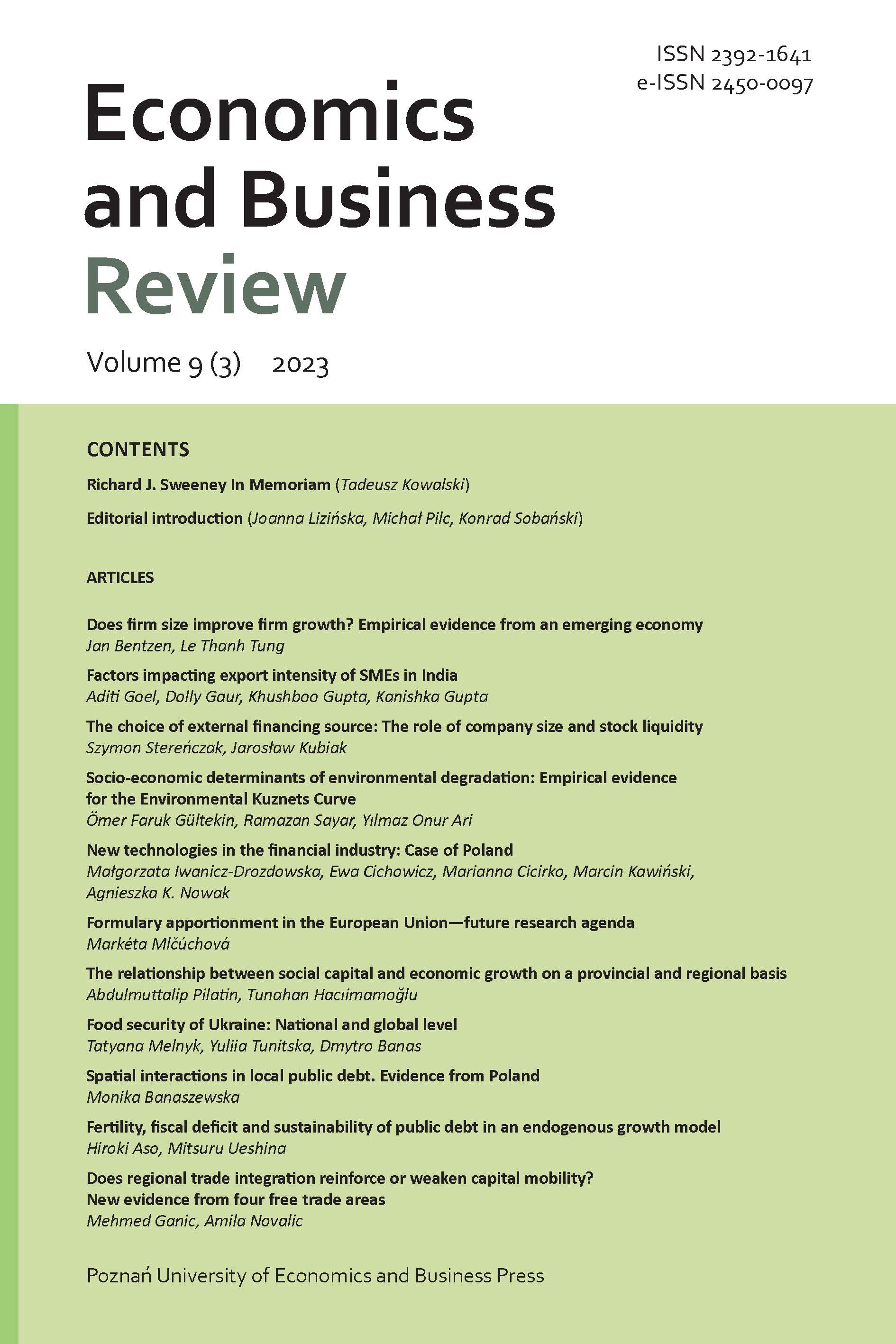
Does regional trade integration reinforce or weaken capital mobility? New evidence from four free trade areas
DOI:
https://doi.org/10.18559/ebr.2023.3.795Keywords:
regional integration, capital mobility, trading blocs, cointegration estimators.Abstract
The study aims to empirically determine whether a higher level of trade openness and the presence of better legal protection for investors enhances the impact of trade bloc membership on capital mobility based on four trading blocs: Eurasian Economic Union (EAEU), Central American and Dominican Republic Free Trade Agreement (CAFTA-DR), Central European Free Trade Agreement (CEFTA), and the Pacific Alliance. This study employs the fully modified and dynamic ordinary least squares estimators and a panel quantile regression cointegration estimator. The study finds that a country's affiliation with a trade bloc improves capital mobility in the whole group and EAEU region, low capital mobility in the Pacific Alliance region and moderate low capital mobility in the CAFTA-DR region. The legal protection system alone provided for the investors does not improve the level of capital mobility unless its interaction with investment is included. Also the study reveals that high trade openness does not necessarily lead to better capital mobility for the studied trade blocs.
Downloads
References
Bayoumi, T. (1990), Saving-investment correlations: Immobile capital, government policy, or endogenous behaviour. IMF Staff Papers, 37(2), 360–387.
View in Google Scholar
DOI: https://doi.org/10.2307/3867294
Behar-Villegas, E. (2022). Absurda lex, sed lex? Public value and the decay of the rule of law: A conceptual perspective. Economics and Business Review, 8(3), 7–26. https://doi.org/10.18559/ebr.2022.3.2
View in Google Scholar
DOI: https://doi.org/10.18559/ebr.2022.3.2
Bilas, V. (2007). Regional economic integrations and capital movement—measuring the level of capital mobility. Ekonomski Fakultet Rijeka, 25(2), 269–290.
View in Google Scholar
Breusch, T. S., & Pagan, A. R. (1980). The Lagrange multiplier test and its applications to model specification in econometrics. The Review of Economic Studies, 47(1), 239–253. https://doi.org/10.2307/2297111
View in Google Scholar
DOI: https://doi.org/10.2307/2297111
Cavallo, E., & Frankel, J. (2008). Does openness to trade make countries more vulnerable to sudden stops, or less? Using gravity to establish causality. Journal of International Money and Finance, 27(8), 1430–1452.
View in Google Scholar
DOI: https://doi.org/10.1016/j.jimonfin.2007.10.004
Coakley, J., Kulasi, F., & Smith, R. (1996) Current account solvency and the Feldstein–Horioka puzzle. Economic Journal, 106(436), 620–627.
View in Google Scholar
DOI: https://doi.org/10.2307/2235567
Collier, P. (1991). Africa’s external economic relations: 1960–90. African Affairs, 90(360), 339–356.
View in Google Scholar
DOI: https://doi.org/10.1093/oxfordjournals.afraf.a098437
Dornbusch, R. (1989). The dollar in the 1990s: Competitiveness and the challenges of the new economic blocs. Federal Reserve Bank of Kansas City Conference.
View in Google Scholar
Drakos, A., Kouteras, G., & Vlamis, P. (2018). Saving, investment and capital mobility in EU member countries: A panel data analysis of the Feldstein–Horioka puzzle. Applied Economics, 50(34–35), 3798–3811.
View in Google Scholar
DOI: https://doi.org/10.1080/00036846.2018.1436150
Dumitrescu, E. I., & Hurlin, C. (2012). Testing for granger non-causality in heterogeneous panels. Economic Modelling, 29(4), 1450–1460.
View in Google Scholar
DOI: https://doi.org/10.1016/j.econmod.2012.02.014
Feldstein, M., & Bacchetta, P. (1991). National saving and international investment. NBER National Saving and Economic Performance, pp. 201–226. National Bureau of Economic Research.
View in Google Scholar
Feldstein, M., & Horioka, C. (1980). Domestic saving and international capital flows. Economic Journal, 90, 314–329.
View in Google Scholar
DOI: https://doi.org/10.2307/2231790
Frankel, J. A. (1991). Quantifying capital mobility in the 1980’s. In D. Bernheim & J. Shoven (Eds.), National saving and economic performance (pp. 227–280). University of Chicago Press.
View in Google Scholar
Frankel, J. A. (1995). Quantifying international capital mobility in the 1980s. In J. A. Frankel (Ed.), Exchange rates (pp. 41–72). MIT Press.
View in Google Scholar
Ganić, M. (2020). Financial globalization. In M. Ganić (Ed.), Financial globalization in the emerging Balkans (pp. 29–47). Palgrave Macmillan. https://doi.org/10.1007/978-3-030-65009-4_3
View in Google Scholar
DOI: https://doi.org/10.1007/978-3-030-65009-4_3
Giannone, D., & Lenza, M. (2004). The Feldstein–Horioka fact. Working Paper series, 873.
View in Google Scholar
Holmes, M. (2005). What do savings-investment correlations tell us about the international capital mobility of less developed countries? Journal of Economic Integration, 20(3), 590–603.
View in Google Scholar
DOI: https://doi.org/10.11130/jei.2005.20.3.590
Im, K. S., Pesaran, M. H., & Shin, Y. (2003). Testing for unit roots in heterogeneous panels. Journal of Econometrics, 115(1), 53–74.
View in Google Scholar
DOI: https://doi.org/10.1016/S0304-4076(03)00092-7
Isaksson, A. (2001). Financial liberalisation, foreign aid, and capital mobility: Evidence from 90 developing countries. Journal of International Financial Markets, Institutions and Money, 11(3–4).
View in Google Scholar
DOI: https://doi.org/10.1016/S1042-4431(01)00042-7
Jansen, W. J. (2000). International capital mobility: Evidence from panel data. Journal of International Money and Finance, 19(4), 507–511.
View in Google Scholar
DOI: https://doi.org/10.1016/S0261-5606(00)00015-2
Johansen, S. (1988). Statistical analysis of cointegration vectors. Journal of Economic Dynamics and Control, 12, 231–254.
View in Google Scholar
DOI: https://doi.org/10.1016/0165-1889(88)90041-3
Kao, C. (1999). Spurious regression and residual-based tests for cointegration in panel data. Journal of Economic, 90, 1–44.
View in Google Scholar
DOI: https://doi.org/10.1016/S0304-4076(98)00023-2
Ketenci, N. (2014). Capital mobility in the panel GMM framework: Evidence from EU members. MPRA Paper, 59014.
View in Google Scholar
Koenker, R. (2005). Quantile regression. Cambridge University Press. https://doi.org/10.1017/CBO9780511754098
View in Google Scholar
DOI: https://doi.org/10.1017/CBO9780511754098
Koenker, R., & Hallock, K. (2001). Quantile regression. Journal of Economic Perspectives, 15, 143–156.
View in Google Scholar
DOI: https://doi.org/10.1257/jep.15.4.143
Kumar, S. (2015). Regional integration, capital mobility and financial intermediation revisited: Application of general to specific method in panel data. Journal of International Financial Markets, Institutions and Money, 36(C), 1–17.
View in Google Scholar
DOI: https://doi.org/10.1016/j.intfin.2015.02.008
Kumar, S., Sen, R., & Srivastava, S. (2014). Does economic integration stimulate capital mobility? An analysis of four regional economic communities in Africa. Journal of International Financial Markets, Institutions and Money, 29, 33–50.
View in Google Scholar
DOI: https://doi.org/10.1016/j.intfin.2013.11.001
La Porta, R., Lopez-de-Silanes, F., Shleifer, A., & Vishny, R. (1998). Law and finance. Journal of Political Economy, 106(6), 1113–1155.
View in Google Scholar
DOI: https://doi.org/10.1086/250042
Levin, A., Lin, C. F., & Chu, C. S. J. (2002) Unit root tests in panel data: Asymptotic and finite-sample properties. Journal of Econometrics, 108, 1–24. https://doi.org/10.1016/S0304-4076(01)00098-7
View in Google Scholar
DOI: https://doi.org/10.1016/S0304-4076(01)00098-7
Markusen, J. R. (1983). Factor movements and commodity trade as complements. Journal of International Economics, 14(3–4), 341–56.
View in Google Scholar
DOI: https://doi.org/10.1016/0022-1996(83)90009-0
Masud-Alam, M., & Rafiqul-Islam, M. (2010). Revisiting the Feldstein–Horioka hypothesis of savings, investment, and capital mobility: Evidence from 27 EU countries. MPRA Paper, 39383. University Library of Munich, Germany.
View in Google Scholar
Matthews, A. (2003). Regional integration and food security in developing countries. Paper prepared for a Food and Agriculture Organization Workshop on Regional Integration, Common Agricultural Policies and Food Security, May 6–9. Pretoria.
View in Google Scholar
Midagu, G., Kwela, B., & Kazadi, J. (2020). Capital mobility in Africa: A re-examination of the Feldstein–Horioka puzzle. Hal Open Science, 03371984.
View in Google Scholar
Murthy, V., & Ketenci, N. (2020). Capital mobility in Latin American and Caribbean countries: New evidence from dynamic common correlated effects panel data modelling. Financial Innovation, 6, 48.
View in Google Scholar
DOI: https://doi.org/10.1186/s40854-020-00204-2
Obstfeld, M. (1986).Capital mobility in the world economy: Theory and measurement. Carnegie-Rochester Conference Series on Public Policy, 24, 55–103. https://doi.org/10.1016/0167-2231(86)90005-9
View in Google Scholar
DOI: https://doi.org/10.1016/0167-2231(86)90005-9
Obstfeld, M., & Rogoff, K. (1995) The intertemporal approach to the current account. Handbook of International Economics, 3, 1731–1799.
View in Google Scholar
DOI: https://doi.org/10.1016/S1573-4404(05)80014-0
Obstfeld, M. & Rogoff, K. (2000). The six major puzzles in international macroeconomics: Is there a common cause? NBER Macroeconomics Annual, 15(1), 339–390.
View in Google Scholar
DOI: https://doi.org/10.1162/08893360052390428
Padawassou, S. (2012). Capital mobility in African countries. International Journal of Business and Management, 7(11), 29–42.
View in Google Scholar
DOI: https://doi.org/10.5539/ijbm.v7n11p29
Payne, J., & Kumazawa, R. (2005). Capital mobility, foreign aid, and openness: Further panel data evidence from sub-Saharan Africa. Journal of Economics and Finance, 29, 123–127.
View in Google Scholar
DOI: https://doi.org/10.1007/BF02761547
Pedroni, P. (1999). Critical values for cointegration tests in heterogeneous panels with multiple regressors. Oxford Bulletin of Economics and Statistics, 61(S1), 653–670.
View in Google Scholar
DOI: https://doi.org/10.1111/1468-0084.61.s1.14
Pesaran, M. H. (2004). General diagnostic tests for cross section dependence in panels. Cambridge Working Papers in Economics, 0435. Faculty of Economics, University of Cambridge.
View in Google Scholar
DOI: https://doi.org/10.2139/ssrn.572504
Pesaran, M. H., Ullah, A., & Yamagata, T. (2008). A bias-adjusted LM test of error cross-section independence. The Econometrics Journal, 11(1), 105–127. http:// www.jstor.org/stable/23116064
View in Google Scholar
DOI: https://doi.org/10.1111/j.1368-423X.2007.00227.x
Pesaran, M. H. & Yamagata, T. (2008). Testing slope homogeneity in large panels. Journal of Econometrics, 142(1), 50–93.
View in Google Scholar
DOI: https://doi.org/10.1016/j.jeconom.2007.05.010
Phillips, P. C. B., & Hansen, B. E. (1990). Statistical inference in instrumental variables regression with I(1) processes, Review of Economic Studies, 57, 99–125.
View in Google Scholar
DOI: https://doi.org/10.2307/2297545
Rocha, F. (2006). Capital mobility in developing countries: Evidence from panel data. Estudos Economicos, 37(3). https://doi.org/10.1590/S0101-41612007000300004
View in Google Scholar
DOI: https://doi.org/10.1590/S0101-41612007000300004
Rymarczyk J. (2021). The impact of industrial revolution 4.0 on international trade. Entrepreneurial Business and Economics Review, 9 (1), 105–117. https://doi.org/10.15678/EBER.2021.090107
View in Google Scholar
DOI: https://doi.org/10.15678/EBER.2021.090107
Shleifer, A., & Wolfenzon, D. (2002). Investor protection and equity markets. Journal of Financial Economics, 106, 1–53.
View in Google Scholar
DOI: https://doi.org/10.1016/S0304-405X(02)00149-6
Sinha, T., & Sinha, D. (2004). The mother of all puzzles would not go away. Economics Letters, 82(2), 259–267. https://doi.org/10.1016/j.econlet.2003.06.002
View in Google Scholar
DOI: https://doi.org/10.1016/j.econlet.2003.06.002
Sinn, S. (1992). Saving-investment correlations and capital mobility: On the evidence from annual data. The Economic Journal, 102(414), 1162–1170. https://doi.org/10.2307/2234383
View in Google Scholar
DOI: https://doi.org/10.2307/2234383
Sobański, K. (2019). ‘Dark matter’ in the external sector of the United States. Economics and Business Review, 5(2), 86–108. https://doi.org/10.18559/ebr.2019.2.5
View in Google Scholar
DOI: https://doi.org/10.18559/ebr.2019.2.5
Stock, J. H., & Watson, M. W. (1993). A simple estimator of cointegrating vectors in higher order integrated systems. Econometrica, 61, 783–820.
View in Google Scholar
DOI: https://doi.org/10.2307/2951763
Syssoyeva-Masson, I., & Sousa Andrade, J. (2015). Capital mobility in the enlarged Europe: A new look at the Feldstein–Horioka puzzle using a quantile regression approach. Dalloz Revue d’Économie Politique, 125, 571–599.
View in Google Scholar
DOI: https://doi.org/10.3917/redp.254.0571
Taylor, A. (1996). International capital mobility in history: The saving-investment relationship. NBER Working Paper, 5743.
View in Google Scholar
DOI: https://doi.org/10.3386/w5743
Tesar, L. (1991). Saving, investment and international capital flows. Journal of International Economics, 31, 55–78.
View in Google Scholar
DOI: https://doi.org/10.1016/0022-1996(91)90056-C
Yildirim, M., & Yildirim, A. (2020). The Feldstein-Horioka puzzle: Evidence from emerging countries. Erciyes Universitesi Iktisadi ve Idari Bilimler Fakultesi Dergisi, 55(1), 141–158.
View in Google Scholar
DOI: https://doi.org/10.18070/erciyesiibd.610470
Yersh, V. (2022). International and regional capital mobility in Latin American countries. Technological and Economic Development of Economy, 28(2), 337–357.
View in Google Scholar
DOI: https://doi.org/10.3846/tede.2022.15912
Downloads
Published
Versions
- 2023-10-12 (2)
- 2023-08-28 (1)
Issue
Section
License
Copyright (c) 2023 Mehmed Ganic, Amila Novalic

This work is licensed under a Creative Commons Attribution 4.0 International License.